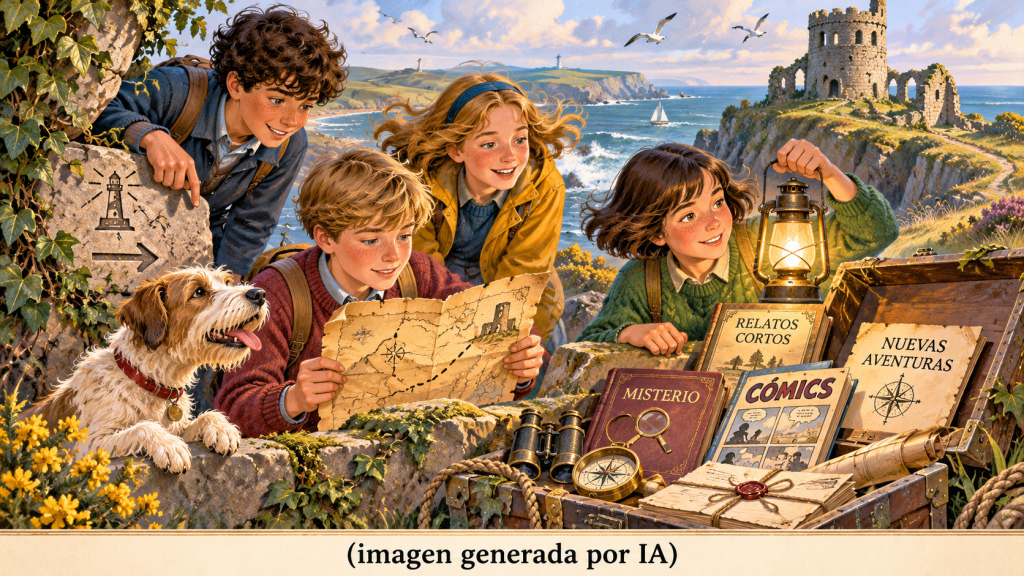
The Famous Five are bigger than their original 21 novels—but those books should never be confused with the spin-offs. There are eight short stories written by Enid Blyton, new illustrated reads written by later authors, graphic adaptations of classic plots and a new generation of adventures. Each has a different appeal and a different creative history.
Five categories, clearly separated
| Format | Creator | Part of the 21 original novels? | Good for |
|---|---|---|---|
| Full-length original novels (1942–1963) | Enid Blyton | Yes, 21 exactly | Confident independent readers, roughly 9+ |
| Eight original short stories | Enid Blyton | No | Shorter adventures and shared reading |
| Newly written colour short reads | Later authors using Blyton’s characters | No | Emerging readers and shorter chapters |
| Graphic novels | Adapters and artists | No, these retell familiar stories | Visual storytelling and comparison |
| The New Famous Five | Chris Smith | No, a new series | Readers ready for more adventures |
Reading ages here are editorial estimates, not a standard rating across all publishers.
1. The eight short stories that Enid Blyton really wrote
Blyton wrote eight Famous Five short adventures, originally published outside the full-length novels and later gathered into collections. Their original titles are Five and a Half-Term Adventure, George’s Hair Is Too Long, Good Old Timmy, A Lazy Afternoon, Well Done, Famous Five, Five Have a Puzzling Time, Happy Christmas, Five and When Timmy Chased the Cat.
Modern editions have featured colour illustrations by Jamie Littler. The short length makes these stories a particularly accessible first meeting with Julian, Dick, Anne, George and Timmy. They are original Blyton stories, but not novels 22–29.
2. Newly created colour short stories by later writers
The estate has also commissioned fresh stories for young readers. Hachette identifies contributors including Michelle Misra and Sufiya Ahmed. Some editions prominently feature Enid Blyton’s name as the creator of the characters; check the full credits to distinguish a newly written text from an original short story.
Examples include Message in a Bottle, The Library Mystery, The Scavenger Hunt and Trouble at the Farm.
Who are they for? Children building stamina for chapter books, families sharing a story over a few evenings, or an older reader who wants a quick mystery between longer novels.
3. Graphic novels: classic mysteries, a new visual language
The French creative team Nataël and Béja adapted classic Famous Five stories into comics; English editions have been released by Hachette. The graphic novel of Five on a Treasure Island (ISBN 9781444963670) is an excellent point of comparison.
It is an adaptation of book 1, not a new case. Readers can compare the layout of a room, the introduction of a clue, or the pace of a chase. Seeing how pictures condense a novel is a valuable reading activity in its own right.
4. Chris Smith’s The New Famous Five
Chris Smith’s new books connect Blyton’s world with a new generation of characters. Readers should know what they are buying: these are new books by Chris Smith, not newly discovered novels by Enid Blyton.
- Five and the Forgotten Treasure — 2025; ISBN
9781444978735. - Five and the Smuggler’s Code — 2026; ISBN
9781444978759. - Five and the Forest of Secrets — 2026; editions have different ISBNs.
They are a promising option after the original adventures, especially for children interested in secret codes, forgotten clues and a return to Kirrin. As with all sequels, expectations should be set by the new author’s style.
Choosing a next read
- New readers: a short illustrated story to share and discuss.
- Novel lovers: start at Five on a Treasure Island and follow the original order.
- Comics enthusiasts: read the graphic adaptation, then compare a chapter with the novel.
- Readers who have finished all 21: try Chris Smith’s series as a clearly labelled continuation.
Turn the mystery into an activity away from screens
Choose one clue from a book and invent a three-step treasure hunt. Ask the children to create an illustrated map, write a coded note and explain how the clues connect. After a graphic novel, challenge them to draw the scene that was most difficult to show without words. The best stories often give us something to do.
Back to the main collection: the 21 original books in order · the story of Enid Blyton and the editions.
Sources
- Hachette: Famous Five original series, short stories and adaptations.
- Hachette: graphic novel adaptation.
- Hachette: The New Famous Five.
Bibliographic note: original stories, retellings, and modern works have distinct credits; availability and ISBNs can vary by format and territory.